Showing posts with label Analysis. Show all posts

Sunday, January 1, 2023

Chase Rate Over Expected

Introduction

Over the past few years, interest in evaluating individual pitches using Statcast data has increased quite a bit. These models, especially the ones created by Eno Sarris and Cameron Grove, have become very popular and are commonly quoted when debating how good a pitcher is relative to others. However, while grading individual pitches and averaging to give an overall score for a pitcher’s arsenal is common, there has been relatively little work done on using individual pitch grades to evaluate batter performance. In this article, I want to evaluate a hitter’s plate discipline by comparing their chase rate against what the expected chase rate is based on pitch quality derived by Statcast data, with the difference being called “Chase Rate Over Expected”.

Methodology

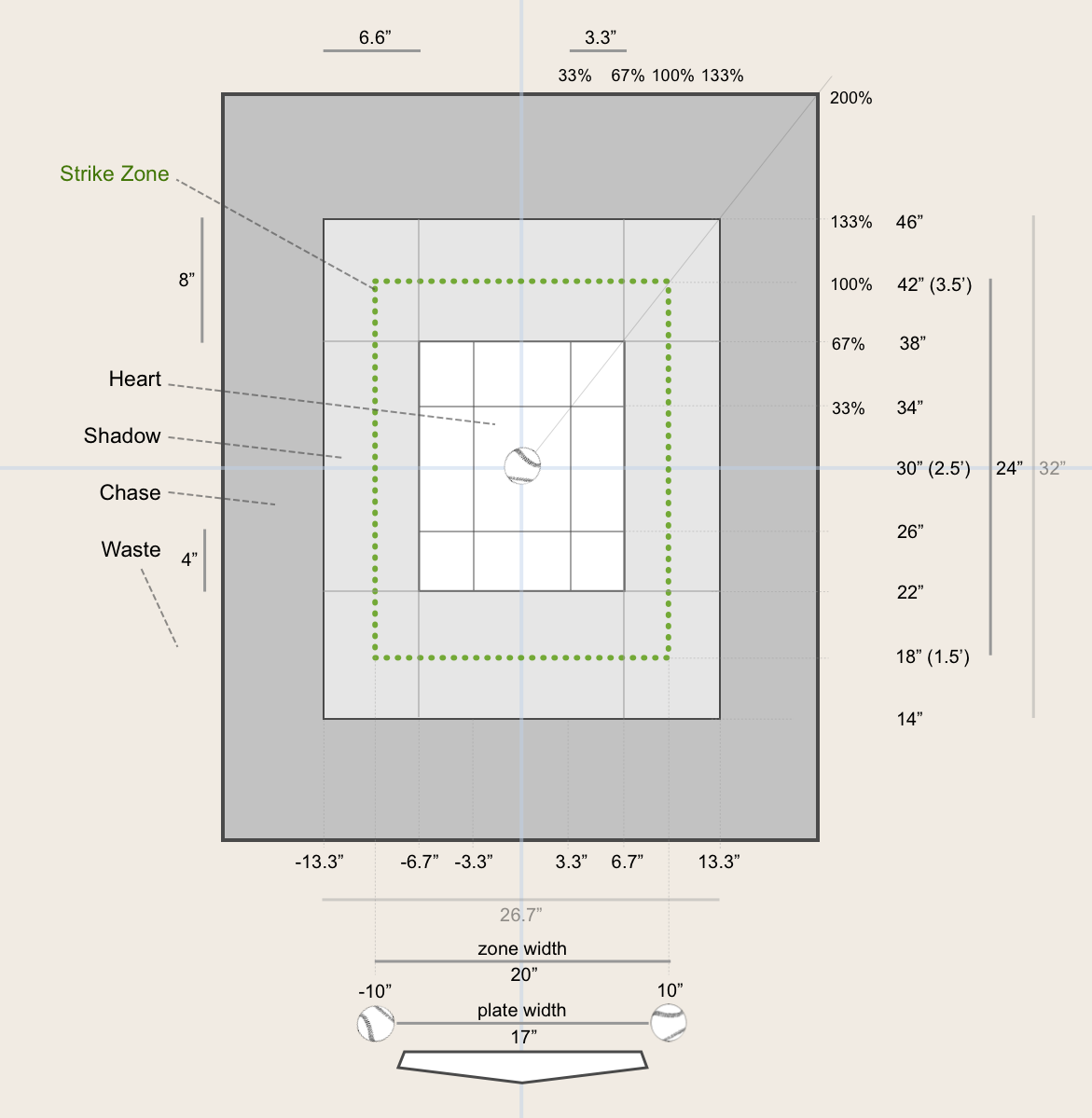
The dataset I used consisted of all pitches thrown in the “chase zone” from 2018 through 2022. The Statcast data provided by Baseball Savant does not directly say if a pitch was in the “chase zone,” so I manually calculated it based on the dimensions defined by Tom Tango (cited below).

To model the probability of a pitch in the chase zone getting swung at, I used a generalized additive model (GAM), with a mix of smooth and non-smooth terms. The smooth terms are an interaction term of vertical and horizontal location and an interaction term for vertical and horizontal movement of the pitch, and the non-smooth terms are speed, spin rate, extension, the count, and a binary term that is 1 if the batter and pitcher are the same handedness, and 0 if not.

Results

Who was in the top 5 in chase rate over expected (CROE) last year, minimum 100 pitches seen in the chase zone.

Top 5

Name

Chase

xChase

CROE

Austin Barnes

11.1%

28.1%

-17.0%

Cavan Biggio

10.9%

26.7%

-15.8%

Max Muncy

12.4%

27.8%

-15.4%

Sam Hilliard

14.6%

28.2%

-13.7%

Triston Casas

11.5%

25.2%

-13.7%


Bottom 5

Name

Chase

xChase

CROE

Francisco Mejia

54.9%

27.1%

27.8%

Javier Baez

51.3%

25.5%

25.8%

Oscar Gonzalez

49.1%

25.7%

23.3%

Hanser Alberto

48.1%

25.6%

22.5%

Harold Ramirez

48.5%

27.5%

21.0%


How stable is CROE year over year? Regressing CROE from the past year to the next year, we get an R^2 of 0.58, which is a decent amount.

How stable is chase rate year over year? Fairly stable, but regressing previous year chase rate against the next season’s chase rate has a lower R^2 than CROE year over year.

Finally, can previous CROE be used to forecast next season’s chase rate better than chase rate from last year? This regression has a slightly higher R^2 than the one that uses prior season chase rate, indicating that CROE does better in forecasting chase rate than previous season chase rate.


Is it fair to give all of the credit to the batter?

One of the implicit assumptions with this methodology is that I am giving all of the credit for the residuals to the batter. If a batter is expected to chase 20% of the time and he only chases 17%, that 3% improvement is all due to the batter’s skill. This is a strong assumption. While I do not think the batter should receive 100% of the credit, because it is impossible to be that correct and the underlying xChase model has natural uncertainty, I do think the batter should receive most of it. The two main factors that the pitcher has control over, which are deception and tunneling, apply to relatively few pitchers that I did not think would drastically affect any one hitter’s rating. However, there are some interesting articles on the drawbacks of “over-expected” ratings in football, and I would encourage readers to check them out. I linked to Robby Greer’s post below.

Conclusion

Overall, I think CROE is a good first step in evaluating hitter’s swing decisions based on the quality of the pitches seen. In the future, being able to control for a hitter’s swing path in evaluating swing decisions for all pitches against certain pitch characteristics would be an interesting thing to study. For instance, it may make sense for a hitter with a flat bat path to swing at more pitches up in the zone than a hitter with a steep bat path. In general, using pitch grade models to not just evaluate pitchers but hitters as well is an important next step in the Statcast era of sabermetrics.

Tom Tango post on defining “Chase Zone”

http://tangotiger.net/strikezone/zone%20chart.png

Robby Green post on “Over Expected” metrics

https://www.nfeloapp.com/analysis/over-expected-explained-what-are-cpoe-ryoe-and-yacoe/


Tuesday, August 30, 2022

How Much Trade Value Did the Rays Give Up in the 2022 Draft?

 While the Rangers shocked everyone by taking Kumar Rocker 3rd overall, the Rays made their own puzzling decision by taking Xavier Isaac, a high school first baseman ranked 113 by Pipeline and unranked by FanGraphs, in the first round. At the time of the pick, I assumed the Rays were planning on cutting an under slot deal for Isaac in the first, and going after another expensive prep player later. Instead, the Rays paid him full slot value and drafted mostly college players the rest of the draft. It’s hard to give a complete scouting report on Isaac; he was injured for the entire showcase circuit, but what I would like to focus on is how much did the Rays sacrifice (or gain) in trade value by making this pick. There are two ways to get value out of a drafted player, either by the player making the major leagues, or whatever you get out of trading the prospect. In this analysis, I want to focus on the latter, because the Rays have consistently been in the playoff hunt and will at least consider trading prospects to improve the major league team, so drafting with trade value in mind is fairly practical.


To start, I want to lay out what the Rays got on the first day of the draft. I will be quoting the prospects’ value in terms of FV given by FanGraphs. 


Round (Pick)

Name

FV (FanGraphs)

1 (29)

Xavier Isaac

35+

2 (65)

Brock Jones

35+

CB-B (70)

Chandler Simpson

40

CB-B (71)

Ryan Cermak

35+


In comparison, the 30-45 range on the FanGraphs board was valued as 45 FV, so the Rays passed up on drafting a good player to go off the board and select Isaac. One thing to note is that Eric seems to be a bit colder on Jones and Cermak than industry consensus, and therefore the Rays draft looks fairly weak. 


Let’s look at the 2022 trade deadline and see what type of players the Rays could get with 2 40 FV’s and 2 35+ FV’s (rounding up on Jones) and compare that to what they could get with a 45 FV, 2 40 FV’s and a 35+ FV. Looking at how FanGraphs broke down the deadline, with the 45 FV, the Rays could get someone like Gallo, a fallen star with an expiring contract, and a couple relievers/platoon bats with the rest of the class, or packaged 45 and the 40’s for Tyler Mahle, a mid rotation starter with 1.5 years of control left. In comparison, the best the Rays could have done with the current class is get a player like Syndergaard, a 4th starter on an expiring contract or Jorge Lopez, a pop up reliever this year who has been dominant, but probably settles into a 7th-8th inning role. As you can see, while measuring trade value is inexact, based on these assumptions there is a large difference in trade value that the Rays gave up to select Isaac.


Now, if Isaac has a strong first half of the 2023 season, the pre draft rankings on Isaac do not matter, especially since teams did not have much to evaluate off of and will be updating their beliefs quicker than usual on him. However, I think the opposite is in play here as well, where if Isaac is just mediocre or below average, teams will write him off quicker than usual. 


To give a hypothetical example, imagine a draft prospect’s rankings from each team as a distribution, so that for a 45 FV prospect, most teams rate the prospect as a 45 FV. Now imagine you are running a team. You are picking 15th, and can choose between Player A, the consensus 15th best player, and Player B, the consensus 50th best player. If you choose A, you are right in the middle of the distribution, whereas if you choose B, you are on the far right of the tail. When you are on the far right of the tail, very few teams want to trade for B for the same amount of value that you think he is worth, whereas that is not the case with A. Furthermore, it’s hard to benefit from variance when you take player B over A. For instance, if player B has a breakout performance, it brings the mean consensus rating to where the right tail used to be, and unless there are a few teams that suddenly value him higher than you pre draft, you haven’t gained any trade value from the breakout performance. In contrast, if player A breaks out and consensus rating increases, you get that increased value since you drafted him at consensus value.


In summary, it’s very difficult for the Rays to do well by drafting Xavier Isaac. A lot of things have to work out well for them to do better than the median value of the slot. However, if there’s one team that has made many people look stupid, it’s the Rays, and so I look forward to see how this plays out in the future and what there is to learn if this works out.


Sources:

https://blogs.fangraphs.com/ranking-the-prospects-traded-during-the-2022-deadline/


Saturday, August 13, 2022

Statistical Inference vs Statcast Models

Since I am currently working on a Stuff model (done in Stan, and hopefully publishing a writeup in their case studies documentation), I have been thinking a lot about the philosophical differences in models that are done with Statcast data versus models built with game level data.

In general, I feel like there is an implicit assumption that models built from Statcast data are always going to be better than ones built with just statistics. I think that viewpoint typically makes sense. Statcast data is more granular, which makes it more feasible to give individuals credit. Fielding statistics as a whole have benefited from Statcast data. It's really hard to properly attribute skill to fielders without granular level data, and new statistics such as Catch Probability and OAA are really impressive pieces of work that show how important Statcast data is and how much we were missing it beforehand.

However, I want to push back on the idea that Statcast models are always better than statistical models. I think this can be especially true in pitching, which may be surprising. Two places where Statcast models can be beat by a well calibrated statistical model is in deception and pitch mix interaction. Deception is something inherently visual and means different things to different people, which makes it hard to quantify. Furthermore we run the risk of overfitting to small data based on this, which can make the overconfident in their perceived edge against others and lead to ruin.

Asking if you want a good stats only model versus a good Statcast model is like the beer or tacos question. You want both, and ideally want them to converge to the same prediction. However, acknowledging the strengths and weaknesses of both approaches and not defaulting to one approach is beneficial in the long run.

Saturday, July 16, 2022

Losing Your Edge in Games Where You Can't Go Broke (and How Successful Teams Start Losing)

Every month, Kyle Boddy releases his/Driveline's internal xERA and Stuff farm system rankings, which have been very informative. The leaders are pretty much who you would expect, it's some version of the Dodgers, Rays, Astros, Yankees, or Baltimore, and some usual suspects like the Royals and Rockies at the bottom. What I find striking is that the A's and the Cardinals are consistently near the bottom of the list. Some teams have been penalized by either promotion or trades (or in the Astros case, forfeiting draft picks), which is not the fault of the organization per say, but the A's and Cardinals do not have this excuse. 

What I find so fascinating about this is that the A's and the Cardinals were at the top of the game in cutting edge analytics. Everyone knows about the A's and Moneyball, and the Cardinals were one of the first teams join the A's in having an analytics based approach. Adopting analytics and being bold was wildly successful for them, as the Cardinals won a couple World Series titles and the A's were very successful despite cheapskate ownership. Now, they seem to have fallen behind by not emphasizing new player development initiatives, which is where the cutting edge of baseball analytics is right now. One example is that Boddy notes how the A's have an extremely fastball heavy approach, which is an old school philosophy that is falling by the wayside. For the Cardinals, drafting Michael McGreevy in the first round feels like a pick that would have been sharp in 2005, but now that we have more than surface level college stats and can look at things such as spin rate and vertical movement, probably is not a great first round pick.

In professional gambling, it's extremely easy to know when you have lost your edge. You lose all your money. In professional baseball, it's not that black and white. In fact, it's super easy to ignore the warning signs by looking at surface level stats and dismissing criticism by saying Twitter isn't real. That's fine. The Cardinals are above .500 and the A's are explicitly rebuilding right now, so from a results based mindset things do not look too bad. This level of apathy can linger for a long time, far longer in comparison to a professional gambler losing his or her edge.

Hopefully both teams can reclaim their boldness and get out of the cellar of minor league xERA. As early adopters, the A's and Cardinals face a problem that many large businesses have the first time they reach growth slumps. It will be interesting to see if they can regain their startup magic.


Setting Informative Priors for Bayesian Mixed Effects Models

 https://rpubs.com/dgerth5/924572

Tuesday, July 12, 2022

Overoptimizing Drafts

As we head into the 2022 Draft, I have been thinking about draft trends and how different the hot new pitch archetype has changed over the past couple years. Nowadays, you can't scroll through baseball Twitter without someone talking about "sweep," but this was not always the case. A few years ago, pitching Twitter was fired up about guys throwing 4 seamers up in the zone, and having a 12-6 or gyro slider to go along with it. This was a very successful strategy, and still is. However, now that we know how good an east-west pitcher can be and how they can be developed effectively, there is less emphasis on drafting the vertically oriented guy. Passing over a guy with a ton of SSW on his sinker just because he doesn't have a carrying fastball is a bad idea, but the public did not have this data a few years ago and thus overreacted (slightly) on traits that could be measured easily and performed well.

My point in writing out this out is to say optimizing your draft for what is popular now does not guarantee future success. If you did nothing but draft pitchers with rising 4 seam shapes and vertical breaking balls, you would have done fairly well. However, if in the later rounds you were debating between a mediocre present stuff vertical oriented pitcher versus a slightly better present stuff east-west pitcher, and you take the vertical pitcher on the assumption that the prototype is more projectable, that probably was the wrong decision, given how good player development has gotten in developing horizontal stuff. Note that I am not suggesting we go back to the days of drafting guys with 88 MPH generic sinkers. These guys are not good.

The easy part is drafting someone and the hard part is maximizing their development. It is a fair point that if a team was not drafting vertically oriented pitchers, they were not also thinking about sweeping sliders or SSW on a sinker and generally did not know how to develop it. The main lesson is to draft the player, not the prototype. If you draft a player because he fits the in vogue prototype, not because you have faith in his tools or a development plan tailor made for him (and lets face it, most teams don't), you might get lucky and get a solid player, but eventually you will get adverse selected by teams pushing the envelope and drafting players based on what they think the game will be in a few years. It's hard to do this well, but the only way to have a robust drafting and developing strategy.

Saturday, July 9, 2022

A Bayesian Comparison of Bond ETF Volatility

Off topic post on bond ETF's and comparing their volatilities:
https://rpubs.com/dgerth5/922557

Monday, June 27, 2022

Who are the Unluckiest Catchers?

I made my first post on RPubs. A quick piece on "unlucky" catchers estimated using mixed effects models. The article is below: 
https://rpubs.com/dgerth5/919614

Thursday, June 16, 2022

Amateur Portfolio Example

In a previous article, I wrote on how I start to think about risk for domestic and international amateur classes, and how decisions in one can affect the other and what makes for the best porfolio. That is linked below. In this article, I want to run through a hypothetical scenario to illustrate what the distributions of two portfolios would look like given certain parameters for what a safe and risky player is for domestic and international players.

To start, I want to define the outcome space for a player. Here, I am saying that a player can either produce 0, 1, or 2 WAR per year, and there is a set of probabilities of being each WAR type given the player type you are. The four player types are "Risky-International", "Risky-Domestic", "Safe-International", "Safe-Domestic." I attached a picture of the probabilities and the corresponding expected values for each player type below. Note the premiums for risky portfolios. Since the risky portfolio is risky, I want there to be a premium for choosing it. Here I chose 10%. Then for the player level, I divided it up equally for each player, and found probabilities that lead to the desired expected value per player.

The next step was choosing portfolio types to sim through. For this example, I wanted to compare a "safe-safe" portfolio and a "risky-risky" portfolio. This means that we should expect to have a mean average WAR of 10% more with the risky portfolio than the safe, but we may prefer the safe one if it provides us with more depth pieces/1 WAR types. This is what the distributional outlay looks like:

This is about what we expected. In 10,000 simulations, the safe portfolio has a slight edge in avoiding outcomes with 0 WAR, and also provides more instances of 1, 2, and 3 WAR, but doesn't provide as many whale portfolios with 4+ WAR as the risky one does.

It's important to note that these are fictionalized distribution probabilities and that we can't draw any real life conclusions from them. I chose to do a toy model instead because I do not have the proper data to make international predictions, and opted for simplicity with the domestic side. In the next article, I will give a more in depth analysis of this example and examine when you may prefer one over the other.

Previous article:
https://davidgerth.blogspot.com/2022/06/setting-up-international-free-agency.html


Wednesday, June 15, 2022

Adam Maier-RHP-Oregon

Adam Maier was the subject of my first blogpost I wrote here. Now that we've reached the end of the season, I wanted to recap how that prediction looked, and also give a full report on his skillset. Earlier this year, I wrote: 

"It’s a stretch to say Maier is a first round arm, but he has one of the best sliders in the class to go along with a couple above average offerings. He’s a ¾ arm slot sinker guy with a fairly aggressive arm action but has enough command to start. Changeup has late fade and tumble, it’s a good out pitch against lefties. Has been up to 97, but velo dropped quick during his starts in the Cape, so this is something to watch. I have him projected as a #4 starter with high leverage reliever utility if the velocity doesn’t sustain. The teams that are more progressive in their pitch sequencing (letting Maier throw 40%+ sliders) should be in on him early and I think would be a great fit for him."

Unfortunately, Maier got hurt at the start of the season and was not able to show off his stuff the way he needed to for him to be a first round pick. From a track record perspective, he has a difficult story. He started his career at the University of British Columbia in 2020, where his first season was cut short due to Covid and his 2021 season was cancelled. The only pitching he did in 2021 was on the Cape, where he threw 25.2 innings with a 4.56 ERA and a 27/9 K/BB ratio. This spring with Oregon, he threw only 15.2 innings for a 4.02 ERA and 19/6 K/BB ratio. It is a thin statistical track record to go off of, which should make him line up very differently from board to board.

From a stuff perspective, nothing really changed from the preseason report. To summarize, he has a heavy sinker that does not miss a ton of bats, but gets a ton of ground balls (68% per Synergy). The concern that he is not able to hold velocity deep into a start remains due to his injury, and this piece of the puzzle is the biggest question mark for him. His slider sits in the 2900-3100 RPM range and is one of the best sliders in all of college baseball. The movement profile on the pitch is a bit "old-school," as it has a ton of vertical break as opposed to the new sweeper sliders. It's a true plus pitch now that projects to be double plus as he throws harder. Maier's changeup isn't as impressive as the slider but it has heavy tumble and fade and is plus in it's own right. It's frustrating looking through Maier's pitch usage chart, where he is throwing 65% fastballs and only 25% sliders and 7% changeups. While I like his fastball, this is clearly a case of a head coach having zero clue what he is doing, and once he gets into pro ball I expect that this will change to something more like 45%/35%/20% FB/SL/CH usage, and I think this poor pitch choice is why Maier's H/9 is not as dominant as one might expect from an arsenal such as his.

The one new aspect that I wanted to touch on was a cutter that was not in the original report. Per Synergy, he hadn't thrown it while he was on the Cape, but did this past spring. Maier only through 5 cutters this spring, so I hesitated to include it in the report, but since it is a pitch that fits well into his arsenal and the general pitching landscape is trending towards the pitch, I think it's worth bringing up. It's a present 30 for me right now, not a ton of feel for the pitch but with slight downer shape similar to the slider. The cutter won't be an impact pitch for him, but having something similar as his slider but harder makes it difficult for the hitter to sit on his slider and gives the cutter big league utility, which is why I am double projecting here.

In summary, I think Maier has a lot of outs to be a starter due to repertoire depth and reaches the bar for command. He may be able to be fast tracked to the big leagues if he is put in a reliever only role, which may not be a terrible idea due to his injury concerns, but it would sacrifice a lot of potential that is impossible to get back. Maier has three present average pitches or above with potential to be plus, and an intriguing cutter.  The medical issues are a legit concern, but I would take Maier over guys like Prielipp and Whisenhunt, who for some reason are rated far higher by many boards despite similar concerns over missed time (less of a concern with Whisenhunt).

Role: #4 starter, with fallback as high leverage reliever

Pitch

Velocity

Present

Future

Fastball

89-93 T97

50

60

Changeup

82-86

45

 60

Cutter

84-88

30

50

Slider

78-82

60    

70

Control


40

45

Thursday, June 9, 2022

Random Notes on Draft Prospects Part Two (Cam Collier, Jett Williams, Brandon Barreira, Carter Young, Zach Neto, Jackson Ferris)

Cam Collier

Cam is one of those guys whose feel for hitting really stands out. He has quick bat speed and plus raw power that he’s able to tap into given the advanced hit tool. Collier doesn’t sell out for power, it’s a fairly flat bat path that enables him to hit the ball anywhere in the zone. His swing can be a little funky at times; he has really low hands and works inside out which limits his pull power, but his feel for hitting is very advanced and is something that I want to bet on.

Defensively, he’s physically maxed out right now and I haven’t seen enough video of him to really say if he will stick at third or if he requires a move to 1B. His defense really isn’t a calling card for this profile though and he’ll hit enough for either position, so I am not worried, and it doesn’t detract from his overall value.

He reclassified to be in this draft by graduating high school early and then enrolling in Chipola JC for this season, making him one of the youngest players in the class. That said, he is an early physical developer and thus isn’t as projectable physically as it may seem from an age perspective.

In summary, Collier is a prime example of someone not just with tools but real baseball skills, and everything about him screams big leaguer. I haven’t seen enough of Jackson Holiday to really make a comparison, but I may end up having Collier over Holiday even though Holiday has the clear positional advantage.

Jett Williams

Williams is an undersized guy at 5’8 180 but with one of my favorite swings in the class. Plus bat speed with a compact swing that has some loft and can reach all parts of the zone. He has average raw power but is able to tap into all of it due to bat path and plate awareness. Plus runner that will be able to stick at shortstop, super twitchy athlete. His ceiling maybe capped due to his stature, but I’m not discounting him here, he feels like a guy whose game power outplays his raw. Jett slots in right behind Holliday and Collier in that second tier of high school hitters behind the big 3 (Jones/Green/Johnson). Really excited about him, think there is a lot of positive traits here.

Brandon Barreira

With Lesko going down with TJ, Barreira might be the first pitcher drafted, and I can see why. He has the best command, a deep repertoire, and a nice frame, but I struggle to see a true plus pitch, and I think the fastball shape is pretty generic. The slider has the best shape of the offspeed, a two plane breaker with late movement and good depth, and I think his changeup plays well shape wise with the fastball. But again, despite the premium velocity I don’t see Barreira missing a ton of bats with his fastball given the current shape and arm slot. Delivery is a bit stiff, lands upright and relies a lot on arm strength. There’s positives here, but nothing that screams top ten pick and I would let him go to college.

Carter Young

Young has taken a small step forward approach wise, with his walk rate improving a few ticks with the K% holding steady at 30%, but the cons outweigh the positives at this point. His approach is well below average, aided by a very steep swing that leads to a ton of strikeouts. It’s worth noting here that there is a difference between Jud Fabian and Carter Young, despite their similarities as big school hitters with funky swings. Like Fabian, Young has a steeper swing, but Fabian only had 1 year running a near 30% K%, whereas Young has 3, and Fabian ran a higher walk rate by about 5%. I’ve been trying to stay away from looking at stats here, but I think it’s important to contextualize the visual look of the swing. It's a 30 bat, with some power but he won’t be able to tap into it. Defensively, he has great actions and is probably the only college infielder that can play shortstop, so there is value, I just think that so much has to go right here for him to even be a viable bench infielder that it’s hard for me to see him as a top 1-2 round player.

Zach Neto

Ton of moving parts going on during the swing but makes hard contact consistently so no real issues there for me. Above average approach that took a step forward this season. I am a little concerned with the steepness in the swing, hasn’t been an issue in small school baseball but may take a little to adjust in pro ball. Performed on the Cape though, so not as concerned. Defensively, he’s not a great athlete and is a fringe shortstop, think he ends up at third due to an above average arm. Obviously there’s more pressure on the bat, but Neto is a nice player that fits in the Top 50.

Jackson Ferris

Ferris reminds me of Maddux Bruns from last season, though with 55-60 stuff rather than 60-70 stuff. Ferris has the prototypical high school pitcher frame, strong physical build with sloping shoulders. He throws from a high ¾ arm slot and has a plus fastball with ride up in the zone, clocking in around 90-94 T97, and a 12-6 curve with plus depth, but loses feel for it at times and thus loses its sharpness. Throws a change occasionally, but not featured much. I really like Ferris, and while he may take more player development help than the other HS pitchers, if matched with the right team (like the Dodgers) he could explode. 


Random Notes on Top Draft Prospects Part One (Elijah Green, Druw Jones, Brooks Lee, Jace Jung)

I've been collecting notes on draft prospects for this year, and I figured I might as well released them. Since I am moving and starting a new job I'm not sure I'll have my rankings as deep as I'd like, but I'll do my best. My plan is to release a set of rankings before the draft, and then hopefully put together a couple posts on specific demographics I am interested in. On to the notes:

Elijah Green

Green is a classic physical toolsy high schooler. He has light tower raw, a bazooka arm and a plus runner, all while being an insane physical specimen at 6’3” 225 lbs. Similar to a lot of these type of players, there’s serious hit tool concerns. Per FanGraphs, he has more swing and miss than balls in play during the showcase circuit. This is a clear problem, but this feels more of a swing path issue rather than a pitch recognition problem, and so I can live with it. From a visual standpoint, his swing is steep and looks like he will have issues with pitches up in the zone but I’m trusting that the team that drafts him can modify his swing to be at least passable up in the zone, and I think there is enough precedent and good hitting coaches who can do this. From my point of view, which is mainly watching video and clips and then reading about how the player did, it’s hard to evaluate hit tools well and players like this I will always have a hard time properly evaluating from my desk. Most of what I have seen has been comments about the bat path though, so I think it’s safe to assume he has fairly good plate discipline, so if the fixable bat path issue gets figured out, he’s going to go off. Best case scenario, Green will make multiple All Star appearances and be one of the dominant players in the league, but there is a ton of variance here and I understand if a team doesn’t want to allocate a large portion of their bonus pool with so much variance. That said, teams with confidence in their PD staff will be rewarded for taking a risk.

Side note: One thing I’ve gotten a little annoyed with is the people putting Green in the 9-15 range based on the hit tool. I think that if you have this much concern about the hit tool, he should be in the 30-40 range (wherever Kendall/Fabian 2020 went). If you think he has some chance to hit, there is no reason not to put him in the top 3-5. There’s no middle ground here in my opinion.

Jace Jung

I think there may be some prospect fatigue here between him and his brother before him. Simply put, Jung is one of the best hitters in college baseball presently, along plus power. It’s not super flashy, he just has excellent feel for hitting and there’s not a whole lot more to say about him. The only blemish is his subpar numbers on the Cape, but it was only 8 games so I don’t really care. Jung is the best hitter in college baseball and deserves to be a top 5 pick, even though he projects as a 2B/3B.

Druw Jones

I was pretty locked in on Termarr being my number one guy, but Druw Jones’s defense gives him an edge for me here, as he will be a plus defender at a premium position. His athleticism and arm (plus) are so impressive that he may get a tryout at shortstop in pro ball. At the plate, there’s no real weaknesses here, as he has plus power, swing decisions, and bat speed. There’s not a whole lot to write out, he’s just extremely impressive. One thing in particular I like about him is that he’s able to tap into his raw power on pitches at the top of the zone due to his bat path being relatively flat. This lets him hit with power against pitches anywhere in the zone. There’s a little stiffness in the swing, but he has the best raw tools in this class and deserves that number one spot.

Brooks Lee

Coming into this season I was cautiously optimistic on Lee. Coming out of high school in 2019, Lee was a highly touted power-driven shortstop. He missed 2020 due to Covid, and then last season had a solid season with a worrisome BB/K ratio, that carried on through his summer on the Cape. Things have gotten better on that front this season and he’s been able to keep the power output, where he is one of the nation’s leaders in average exit velocity. I think I am a little lower on the hit tool than consensus, but it does seem like he has a flexible swing that can cover the upper third of the zone and tap into his power.

Defensively, I’m projecting Lee as a third baseman. Lee is barrel chested and completely filled out physically at 6’2”, 205 lbs. This isn’t a shortstop body. He has a plus arm but just doesn’t have the mobility for short, and with his injury history I am bearish on it getting better. That’s ok though because he still will be able to be an above average defender at third.

He makes good swing decisions and has some pop, but I think he'll end up in the 15-30 range on my board.

Saturday, June 4, 2022

Setting Up the Amateur Portfolio Problem

As mentioned in the Evergreen Research Post, I have been thinking about how to incorporate decisions made in international free agency to the domestic amateur draft and vice versa. For me, the best way to solve this problem is to make a toy model portfolio, comparing the different possible portfolios and run simulations. Then, we can compare and contrast the risk profiles of each, and determine which one is best. In my opinion, there's no optimal way to do this, and depends on where the team is at. If the major league team is bad and the minor league system is a mess, you may have a higher appetite for risk to get a superstar. If the major league team is good and you want to build depth, having a portfolio geared more towards college performers might make sense.

Below, I am going to define what makes a "safe" or "risky" portfolio for both domestic and international classes.

Domestic
For our domestic portfolio, I only want to consider the first 3 rounds. This is where most of the WAR from a given draft class comes from.
A "safe" portfolio is one where the team only selects college players, and a "risky" portfolio is one where the team only selects high schoolers. I understand that there are higher floor high schoolers and toolsy low floor college guys, but for sake of simplicity I want to keep it at this.

International
It's obvious but all sixteen year olds are risky, so I am defining the "safe" portfolio to be one where the team spreads its signing bonus pool over 5 fringy players, and the "risky" portfolio to be one where the teams spreads its bonus pool over 2 good players. I think these definitions accurately describe what most teams end up doing.

Wednesday, June 1, 2022

Research Plans

I wanted to use this entry as an evergreen page of what type of research I am working or topics I am thinking about. Going into job interviews last year, I was not really sure what to expect. I had spent a lot of type working on more abstract ideas and live scouting reports, which are nice, but most lower level jobs require high levels of technical competence, which I was lacking. So I have shifted away from that stuff and have been spending most of my free time trying to get competent in various machine learning packages (xgboost, Catboost, etc) and Bayesian statistics and programming in Stan. The latter is fun and rewarding, but takes a lot of time to get competent with, whereas the machine learning stuff is a little less interesting to me, but pretty easy to bootstrap. That being said, I haven't put aside my scouting (you can see various scouting reports here already, though they are more flowery than what a real scouting report looks like) and I am still doing more in depth research. In no particular order, here is my list of current projects:

1) Bayesian Stuff Model: There's no shortage of Stuff+ models nowadays, but I wanted to try to make something that was fully Bayesian, and also returned estimated swing result distributions (given a swing, it will either be S&M, GB, FB, etc.) rather than a single number. I like the distributions more than a unitless number because I think it's more instructive to see what happens if you add 1 MPH of velocity to your fastball. With a standard Stuff+ model, it will say something like Stuff+ went up 5, which isn't that informative in my opinion. The model I am designing says that if your fastball increases by 1 MPH, your swinging strike rate increases by X%, ground ball rate decreases by Y%, etc. This is done in Stan, which is very time intensive from a programming and a run-the-model stanpoint, and since I want to run it through a Shiny app it's pretty tricky. This is my white whale project.

2) Integrating Domestic Amateur and International Draft Portfolios: I really like considering the domestic amateur draft as a subset of your overall amateur pool. For instance, if you draft three risky high schoolers with your first three picks, this doesn't happen in a vacuum. Your entire international class is also high variance, and thus your youth intake for the season is very high risk. Every team has roughly the same allotment of international talent, and so maybe it's fine to treat domestic and international separate, but I'm curious to see if there's something here that inform how to draft domestically given an international pool and vice versa.


Tuesday, May 31, 2022

Top Early Round Money-Saving College Hitters

Given how much talent there is in the high school ranks this year, it is particularly important to think about ways to give your draft pool the most upside possible. One strategy is to draft a college player underslot, and use the savings to accumulate high schoolers above slot later in the draft. This is a tricky thing to do properly, because you do not want to punt on your first round pick, which is where most of the value comes from, and you also can't fully predict which high schoolers there will be to choose from in the later rounds. I wanted to write about a couple of the top college hitters outside the first round on most big boards that should be in contention for a first round pick as a money saver. I'm ranking these players based on two components, overall potential and round up traits. Something that would be considered an "round up" trait is being a cold weather hitter, where they have less reps and in theory are slightly behind the development curve in comparison to guys in the south. These traits give the overall draft pool some of the positive convexity you get when drafting a standard first round talent. The players listed here are roughly in the 40-80 range of most public big boards.

Josh Kasevich-Oregon
The prototypical college shortstop is very boring, but Kasevich is exciting. Kasevich brings a plus hit tool and above average raw to the table while being a capable defender at short, but hasn't shown his power in game. Kasevich has some late bloomer traits that make him interesting and have me rounding up on his power. Taking a cursory look at his spray chart, he's gone from an oppo hitter to more of a pull hitter, indicating that he can make adjustments. I have him with a first round grade, but industry consensus has him more of a second rounder.
Max Wagner-Clemson
His report is already on the site so I won't get into him too much, but he is a cold weather bat with some specifically interesting traits (impressive ability to do damage on pitches up in the zone) that give him intriguing upside. Lack of experience outside of this year is scary.
Dalton Rushing-Louisville
Rushing isn't a great defender behind the plate, but with the ABS coming at the time when he'd make his big league debut I'm not so concerned. He was hidden behind Henry Davis so he does not have much of a track record, but he performed well on the Cape and continued to a strong junior season. He has a hulking frame and has plus raw power, that he has no issue tapping in to because of his average hit tool. Most guys that look like him have contact problems, and while he runs a strikeout percentage that is a little hot (20%), he has a good approach at the plate. It's a good set of tools and while there may not be a ton of defensive value to bank on, you are getting a power hitter with real feel to hit
Sterlin Thompson-Florida
I might be cheating here as Pipeline has him #27, but I've seen him more in the 35-50 range so I'm including him here. Thompson has a good feel for hitting with enticing raw power that hasn't fully been developed yet. No real defensive home, has played 2B/3B/COF, don't love his actions in the dirt so most likely in the oufield for me. No real round up traits here as he is a Florida kid, but it's a hit over power profile in a power hitter frame so I think there is exciting upside here that hasn't shown up in the box score.
Cayden Wallace-Arkansas
Wallace played a full freshman season, unlike Max Wagner, and did fairly well hitting .279 with 14 HR, but ran a high K%. Wallace is a fringy hitter with big power and a physically filled out frame and a plus arm. Wallace and Wagner have pretty much the same profile, but I think there is more certainty that Wallace is a fringe hitter whereas Wagner has more variance.

Thursday, May 19, 2022

Where Does Ben Joyce Fit In?

Ben Joyce, the flame throwing right hander at Tennessee, has been another difficult player to value in the draft this year. Similar to Jacob Berry, I think he offers an interesting conversation of modern player valuation, as the value of relievers has changed over the past few years. 

Let's start with a report on Joyce. At this point, we all know what he does. He has the best fastball in college, and quite honestly it is one of the best in all of baseball today. His primary offspeed is his slider, which has a good shape to it with plus lateral movement, but it's relatively slow (low 80's) and he does not have enough feel for it yet. Unsurprisingly, Joyce's command is not very refined, but at the velocity he is throwing it's good enough.

Due to his otherworldly stuff, Joyce is a fan favorite on Twitter. However, this production on the field doesn't quite matchup with what Twitter says. He's only thrown 26 innings this year, which seems low relative to the media coverage, with a 45/9 K/BB ratio and 0 saves. I bring up the 0 saves number because I think there are some red flags here that Tennessee isn't having a guy who throws 100 MPH consistently close out games. It also isn't the case that they are sabermetrically inclined and want to put him in more high leverage situations rather than just saves, he's thrown a lot of midweek games. 

Most of the appeal of drafting Joyce in the first round is that he can very quickly pitch in the big leagues, ideally this season. Instead of trading for a reliever at the deadline, you can grab him in the draft and not give up anything, aside from opportunity cost. I think this scenario working out well is highly unlikely, to the disdain of PitchingNinja junkies. No matter how well Joyce's stuff is (which is essentially 1.5 pitches), having close to 0 high leverage innings under your belt and then getting pushed to the majors is a recipe for disaster, and if you are a contending team I would hope you have better minor league depth. 

While I love Joyce's stuff, contending teams that would want his great stuff should have the depth to not need him. If you are relying on him to save your bullpen, as a player development group you have failed. Teams that go in 3-5 year boom/bust cycles may want Joyce, but if you have the ability to develop pitchers from anywhere, the opportunity cost of drafting Joyce in the first round is just too high, in my opinion.

Again, it's important to not get bogged down with the minuses. This dude has the best fastball since Stephen Strasburg, and if he gains more feel for the slider, he is going to provide Chapman level production out of the pen. If he develops a changeup, he has an outside shot of being a 4 and dive starter, but his present stuff is so good and valuable to a bullpen that I doubt the team that drafts him tries to develop it. Also, from a Kelly variance perspective, Joyce is quite valuable, since it's extremely likely he makes the major leagues. I just think drafting him with the expectation that he pitches this October is misguided. Hopefully the Dodgers take him and make me look stupid.

Tuesday, May 17, 2022

In the Weeds (Again) with Jud Fabian

Having done this fairly seriously for a few years now, and writing about the draft portfolio/roster construction for two, I think that Jud Fabian has been the trickiest player for me to evaluate and value. Earlier last month, I wrote a blog where I was extremely confident that he was a top 10 pick. Today, I am a less sure.

First, a quick update about his tools. Nothing about his upside has changed in a month; his plusses are still clear. Where I have gotten more concerned about is his K% and (this may sound unscientific) his batting average, which is concerningly low even if the stat is flawed. Looking at SEC numbers only, Fabian is currently hitting .162 with a 36% K%, which is quite concerning. In my original writeup, I was looking at his overall stat line, where he looks far better, and assuming it was roughly the same in SEC play, but clearly I was being too lazy. So while his strengths (power, defense, bat speed) are still evident, I was too optimistic on the improvement of his hit tool. However, I don't want to write him off completely, and so I want to try to think about what situations would justify a high Jud Fabian pick.

Bonus Pool Standpoint 
While I am not satisfied with my work on the Kelly Criterion, I think one part of the research that helped me was being able to think about variance in relation to bet/signing bonus size. Essentially, the higher the proportion of our bonus pool money spent on one player, the less variance we should want. This is pretty obvious, but within this framework it is essentially impossible to draft a high school pitcher within the first ten picks, a viewpoint that was not common pre-analytics revolution (and still isn't I guess, Jackson Jobe and Frank Mozzicato were both top ten picks last season). So, for first round picks we do not want to be taking gambles and in general should be taking "safe" players. Note that safe does not necessarily mean college player or have a 70 hit tool. I consider someone like James Triantos a safe draft pick because he has a plus hit tool (which is fairly sticky) to go along with average power and solid defense, so he has no real caps. 

When looking at Fabian through the "Kelly" lens, it's hard to make the case that offers the same or better upside with less variance than other players in the top half of the draft. At this point though, I think that players such as DeLaughter, Cross, and to some extent Dylan Beavers have just as high of an upside as Fabian while being less volatile, and would be more comfortable investing a high pick in them over Jud.

Team Specific PD
While Fabian is certainly a risky player, in some cases risky players can be less so due to a strong Player Development department, and can thus justify a high draft pick for Fabian. This is once again obvious, but very hard to quantify and if you have the right group now, there is no guarantee you will in the future as there is a lot of turnover in these positions. Looking through the usual suspects (LAD, HOU, etc), I don't evidence of them developing guys with concerning K%'s, with LAD most noticeably drafting one (Jeren Kendall) and whiffing on him. A more complete study than a cursory ten minute glance is in order though.


Saturday, May 14, 2022

Jacob Berry Report and General Thoughts on Valuing DH Type Prospects

Jacob Berry has one of the strongest statistical resumes amongst college players in this years' draft class. After posting a .332/.439/676 slash line with 17 HR and a 33/58 BB/K ratio at Arizona State (a fairly hitter friendly environment), he transferred to LSU, where he has kept up his dominance despite a nagging finger injury. With this track record, it's easy to envision him as a top 5 pick, but he has some warts that make him a unique player to value, and make for an interesting discussion on roster construction and where baseball may be headed.

To start, he does exactly what you want offensively. Berry has an immaculate swing that is perfectly optimized for power and contact. There is loft in the swing, but his swing isn't so steep that he can't reach pitches up in the zone. From the looks I have seen, he has very few holes where pitchers can target. He makes strong swing decisions, and has a plus feel for hitting overall. In terms of pure hit tools, he's in the Jung/Termarr/Lee class of hitters.

Now lets move to the warts. The first one typically wouldn't be, but it is because of the second. From his stat line, Berry looks like a prototypical masher with great plate discipline, but his raw power is not all that impressive. It's above average raw, but he relies a lot on his feel for contact to clear the necessary power bar for his position, which is 1B/DH. Most of the 1B/DH types are the opposite; they have big raw power and no feel to hit. In general I tend to think that hit tools are fairly sticky, so I'm less worried about Berry and think his hit tool will let him get enough power, but this is a concern worth vocalizing.

The more pressing concern with Berry is how bad his defense is. Going into the season, the consensus view was that he was a 1B/3B that was most likely ending up at 1B, but now I think it's pretty obvious he is a fringe 1B and most likely a DH. The nagging injury could play a part in why he looks so bad defensively, but he is not very fluid in general and I am skeptical he will be even a fringe defender at first, which is a very large cap.

Finally, I was to summarize Berry through the lens of the new universal DH rule, and how this affects his overall value. In my opinion, there are two ways of utilizing the DH spot. The first is to use the standard Adam Dunn type masher as your DH. These guys have their value and make a lineup's run production higher, but they offer very little in terms of roster flexibility. The second option is to use the DH as a quasi load management tool, which requires more utility bats that are flexible enough to play two or three positions well. I prefer the later utilization because it allows for more robust roster management and rewards good player development and building depth in the minor leagues, even though there are some aspects of being a DH that may make players uncomfortable and negatively affect performance.

Since I prefer the second option for DH's, I will most likely have Berry lower than consensus, and more specifically, lower than teams that prefer the first option for DH. His lack of defensive value hurts him heavily, even though I do love his hit tool and believe he can hit for enough power. From a draft class/signing bonus pool point of view, Berry's cap adds a lot of variance that I want to avoid when spending a large amount of my bonus pool on a college hitter. 

Sunday, April 17, 2022

Jud Fabian Thoughts/Report

Given that Indiana baseball is pretty weak this year draft wise, I've been starting my overall top prospect list a lot earlier than I normally would. This list is based off of video clips and stats, so certainly not a great list but I've done reasonably well over the past couple of years and I think I'm pretty good at synthesizing information that is relevant. Obviously team lists are far better, but it still is a good exercise in video scouting and contextualizing with (surface level) stats.

I'm going to talk more about him in the official list, but the player who has interested me most this cycle and almost feels underrated at this point is Jud Fabian, CF from Florida. As of right now, Fabian is a top 10 pick and I don't really see him getting bumped out.

This is an excerpt of my writeup on Fabian:  

"I think for model driven people Jud Fabian is going to be really difficult to value properly. From a demographic standpoint, his plusses are his age, his excellent senior year BB/K ratio, and his raw power, but it’s weighed down by a horrific junior season (from a plate discipline standpoint) that forced him back to Florida his senior year. This is a really difficult situation to model, as there are very few players like him.

Zoning out and looking at what he does well gives a pretty clear picture as to why he’s a top 10 pick. Fabian has plus power, above average speed, will be able to stick in center field (giving him a lower offensive bar, not that I think he needs it), and a plus arm. These sorts of tool freaks tend to have poor plate discipline, but that really isn’t the case here. Most of his swing issues from junior season come from a very steep bat path that is conducive to having a lot of strikeouts. If this was a pitch recognition issue, it would be far more concerning, and probably would be an early second round guy. From the video I’ve seen, it doesn’t seem to be the case. I think it’s hard to pass up an opportunity to draft someone with above average to plus tools across the board aside from the hit tool, where the main issue is a mechanical one (ie fixable) rather than a pitch recognition one (less confident this is fixable).

Now it’s a pretty big concern that the mechanics are heavily optimized for one part of the plate and not the others, since teams are more creative now with their pitches and are more than willing to exploit any weakness in the strike zone than just throwing fastballs down and away. This optimism comes from the thought that in general, teams are better at making swing adjustments than in previous years. 

One final note is that if we say that SEC competition is roughly A ball, which I think is fair, then in the context of Jud repeating A ball as a 21 year old, we would be pretty happy with his performance and discount the prior season pretty heavily, at least in my opinion."

It's very hard to make the major leagues, and you need to have outlier tools. Fabian has a couple and plays a premium position, which makes me overlook his flaws. It's not a complete package, which is risky, but the payoff could be extreme, and for teams that know how to integrate PD and scouting and can line up their PD's strengths with Fabian's weaknesses, this is a future All-Star. Looking at where he could go in the top 10, I could see the Cubs on him at 7 based on their Christian Franklin selection last year, and the Royals at 9 could be another great fit given their recent track record of player development and how well it has been the last few years.